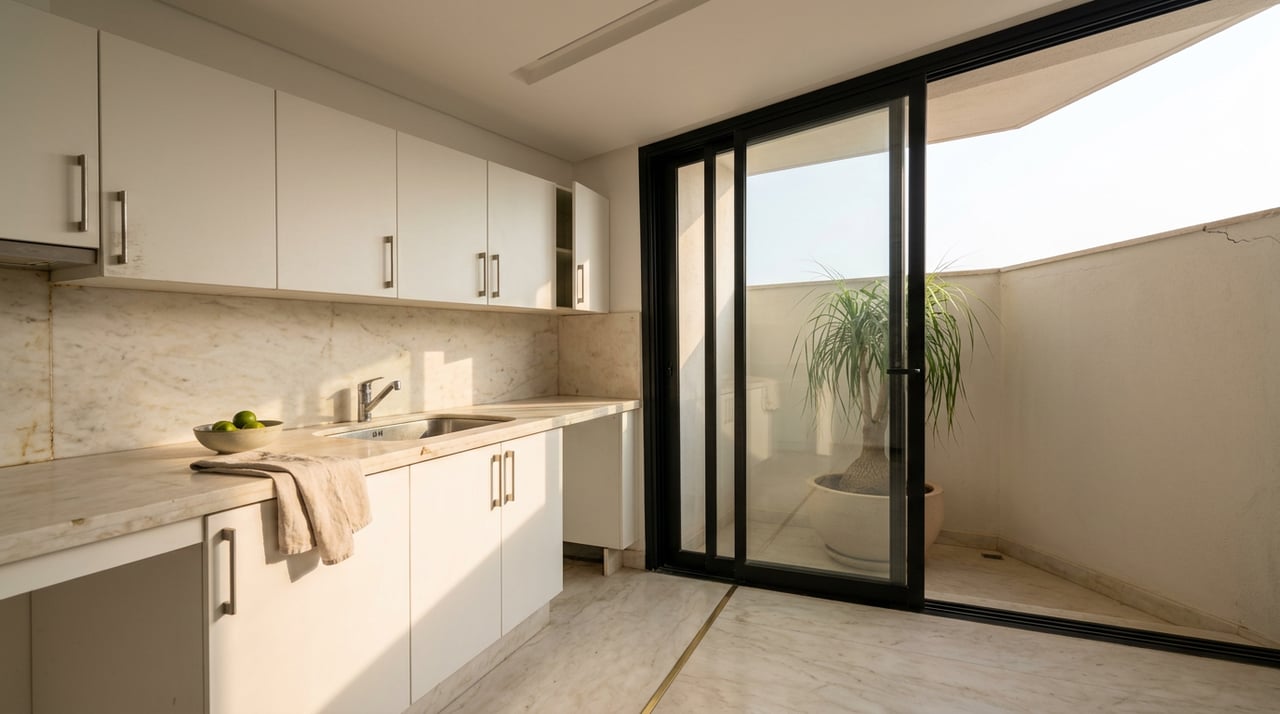
A two-bedroom condo at Terrasol listed for $695,000 this summer works out to $399 a square foot. The citywide Cabo San Lucas condo average, as of early July 2026, sits at $394 a square foot, with an average listing price of $673,739. Terrasol is beachfront on Solmar Beach, sits between the Waldorf Astoria Los Cabos Pedregal and Grand Solmar, and is a five to ten minute walk from the Cabo San Lucas Marina. By almost any logic of location, that address should carry a real premium over the citywide average, not track five dollars above it.
It doesn't, and the reason has nothing to do with the beach. It has to do with what you're actually buying when you buy at Terrasol, which is not one condo product but roughly 140 separately owned, separately renovated units that happen to share a gate, two pools, and a palapa restaurant with a swim-up bar.
The Same Building, Six Very Different Prices
Terrasol was built in 1990, and it has never operated as a single branded rental program the way many newer Cabo resort-condo towers do. Most units are individually owned, and owners rent them independently through whatever mix of agencies and booking platforms they choose. There is no association-run rental pool setting a floor on income or a standard on finish quality. What that means in practice shows up clearly across current listings in the same building:
| Configuration | 2026 Asking Price | What Sets It Apart |
|---|---|---|
| Studio, third row from the beach | $539,000 | Remodeled interior |
| 2 bed / 2 bath | $575,000 | Marketed for its original Baja character, not a full remodel |
| 2 bed / 2 bath, once owned by boxer Oscar de la Hoya | $675,000 | Fully remodeled |
| 2 bed / 2 bath, 1,742 sq ft | $695,000 | Marina view, tracks almost exactly to the citywide per-square-foot average |
| 3 bed / 3 bath | $850,000 | Completely remodeled |
| 1 bed / 2 bath | $1,100,000 | Marketed as the resort's top-performing rental unit |
Notice what doesn't explain the spread. It isn't bedroom count. A one-bedroom is asking more than a three-bedroom in the same building, because that one-bedroom carries a documented rental track record and the three-bedroom is simply well finished. It isn't square footage in any consistent way either. What actually separates a $539,000 studio from a $1,100,000 one-bedroom is renovation history and, for the top performer, a reputation for rental income that a buyer is paying to inherit.
Why Fragmented Ownership Beats Location Every Time
Newer resort-condo towers along the Corridor tend to ship every unit with matching finishes and often a single management company running the rental program, so the building's median price is a reasonable proxy for what any given unit is worth. Terrasol works the opposite way. Buy at Terrasol and you're buying into a shared address and shared amenities, but the condition of your specific unit and the strength of your specific rental arrangement are variables the building itself does nothing to standardize.
That gap is visible even within the resort's own marketing. A small local rental operator called Terrasol Elite curates a collection of nine of the roughly 140 units, run by two people, Lorraine and Monica, who manage bookings personally rather than through a call center. The entire premise of that curated collection is that it stands apart from how the rest of the building is rented and maintained. If every unit at Terrasol delivered the same experience, there would be no reason for a boutique operator to exist inside the same gate, distinguishing its handful of units from the rest of the inventory.
For a buyer, this means the citywide average price per square foot tells you almost nothing about what you'll pay for a specific unit at Terrasol, and the building's beachfront address tells you even less. What you're actually pricing is the individual owner's renovation decisions and rental history, unit by unit.
The Renovation Calendar Nobody Puts in the Headline
There's a seasonal detail worth knowing before you make an offer or plan a purchase around rental income. Because most owners renovate independently, and because Terrasol's slow season runs roughly May through October, that stretch is also when construction is permitted throughout the property, typically between 9 a.m. and 5 p.m. Guests booking during those months have been warned in listing descriptions that drilling and hammering from a neighboring unit under renovation is a real possibility, not a hypothetical one.
For a buyer, that cuts two ways. If you're purchasing an unrenovated unit and planning your own remodel, you have a defined window to do it without competing against high-season occupancy. If you're purchasing a finished unit and counting on shoulder-season rental income, you need to ask whether neighboring units have renovation work scheduled, since noise from someone else's remodel can affect your guest reviews and your rates just as easily as your own.
What Due Diligence Actually Looks Like at Terrasol
Because the building doesn't standardize condition or rental performance, the questions that matter here are different from what you'd ask at a newer, single-operator resort tower.
- Ask for the specific unit's renovation date and materials, not the building's construction year. A 1990 building tells you nothing about whether the kitchen was redone in 2024 or never touched.
- Ask whether the current owner self-manages the rental or works through an agency, and request whatever occupancy or rate history exists. A unit's asking price may be built on a rental reputation, and you should see the numbers behind that reputation before you pay for it.
- Confirm whether any neighboring units have renovation work planned or in progress, particularly if you're buying between May and October.
- Understand that HOA dues at a property like this typically cover shared security, pools, and common areas, not the interior condition of any individual unit. That's a separate line of diligence entirely.
One more detail applies to any Cabo purchase, not just Terrasol, but it matters here given how many of these units trade in the same building at different price points. Mexican regulation NOM 247 requires that a dollar-denominated asking price be converted to pesos at the official Banco de México exchange rate on the date payment is due, not the date you signed the offer. On a unit priced anywhere from $539,000 to $1,100,000, that conversion detail is worth building into your closing timeline rather than discovering it at the notary's office.
If you're weighing Terrasol against a rental-focused purchase elsewhere in Cabo San Lucas, our short-term rental buying guide near Medano Beach walks through how income expectations shift depending on whether a building runs a unified rental program or, like Terrasol, leaves that entirely to individual owners.
FAQ
Does Terrasol have a rental pool like some Cabo resort-condos do? No. Units are individually owned, and most owners market their rentals independently across various agencies and platforms rather than through one association-run program.
Is the building's 1990 construction date a dealbreaker? Not on its own. Several units in the building have been fully remodeled with high-end finishes, but because there's no building-wide renovation standard, you have to verify each specific unit's history rather than assume anything from the building's age.
What should shape my offer more than the building's average price? The specific unit's renovation vintage and, if you're buying for income, its documented rental performance. Those two variables explain more of the price spread at Terrasol than location or square footage ever will.
Terrasol rewards a buyer who does the homework on a specific unit rather than one who trusts a building-wide average. If you're comparing this address against others in Cabo San Lucas, Own In Cabo Real Estate can walk you through the current inventory unit by unit, including renovation history and rental performance where it exists. You can also learn more about the surrounding Cabo San Lucas market or reach out to Patrick Neal directly to start your search.