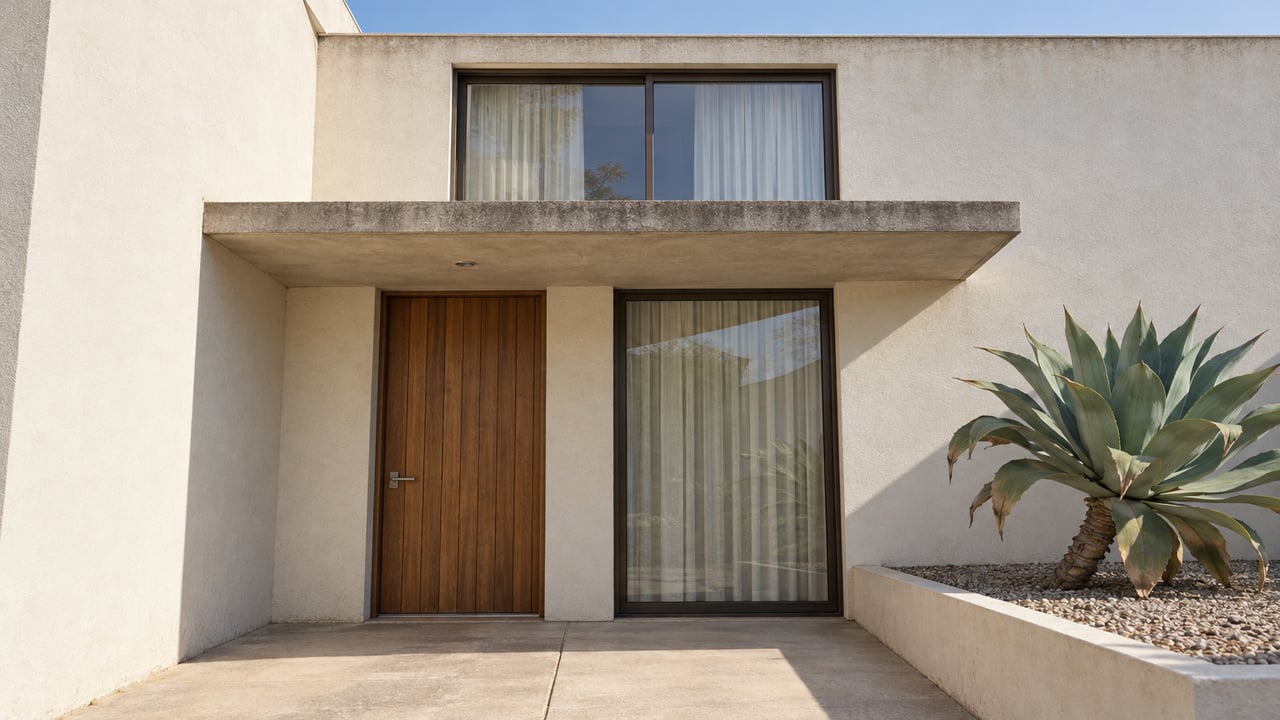
Maranata's spec sheet lists 26 two-story homes, each with three bedrooms and two and a half baths in 1,650 square feet. Every home has city water and its own 5,000-liter cistern. The community runs its own sewage plant and has 24-hour security, a shared pool and low HOA dues, all about ten minutes from downtown Cabo San Lucas on the Cabo Corridor. Buyers comparing these homes tend to focus on bedroom count and dues. The line that shapes daily life most is the cistern, because in Cabo San Lucas "city water" means water delivered in turns.
That is why a cistern inspection belongs near the top of a Maranata due-diligence list, and why the size of the tank tells you more about living here than the square footage does.
City water in Cabo San Lucas arrives on a rotation
The municipal water utility, OOMSAPAS Los Cabos, supplies Cabo San Lucas through a rotation called the tandeo. Different colonias get pressurized water on different days, and the list changes. On September 9, 2024, Análisis BCS carried the utility's rotation for that day. It listed 18 Cabo San Lucas colonias receiving water, mostly at night, and noted that the schedule could change with well operations, logistics, outages, leaks or repairs. An April 10, 2024 daily list published by Tribuna de México included El Tezal and Villas El Tezal, at the same Cabo San Lucas end of the Corridor.
Those lists are more than two years old, and nobody should read them as a current calendar. They show how the system works. Water reaches a given street on a given day, often overnight. Between turns, a household runs on whatever it has stored. In a Maranata home, that store is the 5,000-liter tank.
So the cistern is the house's real water supply. The city connection refills it.
The gap between turns can get very long
How long a tank has to last depends on how reliably the network refills it, and in 2026 that varies a lot across the city. In a May 27, 2026 report, Tribuna de México covered the arrival of 20 municipal tanker trucks of 10,000 liters each, plus two Vactor units, bought through the city's environmental sanitation trust, FISAM. Water director Arturo Sandoval explained how the trucks would be split, as Tribuna reported:
"We have to be bringing water to almost 70 government institutions in Cabo San Lucas. These pipas will be assigned half to public buildings and ten more to zones where the water shortage in Cabo San Lucas does not let the networks fill in two or three days."
Those municipal deliveries are free. The same report said they would go mainly to colonias in the northern part of Cabo San Lucas, where families receive water on average only about once a month. That figure describes the northern colonias, not the Corridor. It matters to a Maranata buyer because it shows how widely refill intervals vary within one city served by one utility. A buyer's question is where a given address sits within that range, and the answer comes from the people already living there.
For scale, each new municipal truck carries twice what a Maranata cistern holds.
The relief everyone expects keeps moving
The usual answer to all of this is desalination. Cabo San Lucas has one working plant and a second under construction. Both are central to the story, and the 2026 record on each one gives a reason for patience.
Plant 1 passed to OOMSAPAS operation by September 2025. At that point the mayor said it had been producing 60 liters per second, with a goal of at least 180. Then came the late-August rains. In an August 26, 2026 notice, OOMSAPAS reported a general supply disruption caused by electrical failures. Power had come back, but sources were restarting gradually. On Acueducto 1, two wells were running and three were waiting on CFE, the federal power utility. On Acueducto 2, seven wells were running and one was out. Plant 1 still couldn't start because the electrical supply was too weak. The utility warned that bringing the network back to pressure would take time. A plant's rated capacity and the water that actually reaches homes are different numbers, and the second depends on the power grid.
Plant 2's timeline has drifted over the past two years:
| Date of source | What it said about Plant 2 |
|---|---|
| February 2024 | Operation was then expected in 2025 |
| April 2025, federal project record | 250 liters per second, 25-year public-private contract with La Peninsular Compañía Constructora and Acciona Agua, construction estimated to finish December 2026 |
| January 2026 | Over 60% complete at a November 2025 inspection, with operations not starting until 2027 |
| March 2026, OOMSAPAS | Transpeninsular pipeline crossing complete, with filters, tank connections and pump station still in progress |
| June 2026 | Mayor reports 73% complete, about MXN 1.8 billion invested, more than 464,000 beneficiaries |
The sources behind those rows are the federal project record, the January 2026 Meganoticias report, the OOMSAPAS construction update, and the June 19, 2026 Palabra BCS report quoting the mayor. The 73% figure from June is the latest progress number in those reports, and none of them gives a firm start date newer than the January projection of 2027.
For someone buying in Maranata this fall, the plant is real, mostly built and important, and the most recent published projection puts its start in 2027. Until it runs, the tank in the house does the work. Even after it runs, August showed that supply also depends on wells, power and network pressure.
When the tank runs dry, the price is whatever the truck charges
When a cistern runs low between turns, the backup is a private water truck, or pipa. Nobody publishes a price list for them. In June 2026, Tribuna de México reported Conagua's statement that it doesn't regulate tanker transport or tanker-sale rates. In March 2025, a Los Cabos councilwoman told Hoy BCS that no price schedule for pipas exists. An April 2026 commentary in Península Digital reported private trips costing MXN 2,500 to 5,000 depending on distance and urgency, without saying what size truck that bought. The same piece cited 200 liters sold for MXN 180.
Those are examples from one article, not a market rate. They do show that a home's water bill has two parts. One is the OOMSAPAS charge, which follows the published tariff documents on the utility's rates page. The other is whatever the household spends on trucks, which no public schedule sets. A larger, well-maintained cistern lowers the odds of needing that second part.
What a Maranata buyer can actually check
Since the cistern does so much of the work, it gets as much attention in due diligence as the roof or the air conditioning. With Patrick Neal's construction background, these are the items our team raises on homes with private storage:
- Tank condition. Get the cistern inspected, including its lid, any signs of leaks or cracking, and how recently it was cleaned.
- Pump and pressure equipment. A cistern only helps if water gets from the tank to the faucets, so test the pump and any pressure system.
- Refill history. Ask the seller how often the tank refills from the city connection and whether they have ever bought pipa water. If they have, ask how often and what they paid.
- The community's systems. Maranata runs its own sewage plant. Ask the HOA who maintains it, what it costs and how those costs appear in the dues.
- Usage pattern. A full-time household of three bedrooms uses water differently than an owner who visits part of the year or rents the home out. Match the tank to how you plan to use the house.
None of these items is unusual. In a city where supply comes in turns, the answers tell you more about how the home will function than the listing photos do.
FAQ
Does Maranata have city water? Yes. Every home has a city water connection plus its own 5,000-liter cistern. The cistern stores water between refills, because Cabo San Lucas distributes city water on a rotating schedule.
When will the second desalination plant start running? A January 2026 report projected operations in 2027. The most recent progress figure, from the mayor in June 2026, was 73% complete.
Are water truck prices regulated? Conagua said in June 2026 that it doesn't regulate tanker transport or tanker-sale rates, and a Los Cabos councilwoman said in 2025 that no price schedule exists.
This post is general information about public water infrastructure, not legal, financial or engineering advice. Confirm the details of any specific home with a qualified inspector, the HOA and the right professionals.
If you're considering Maranata or another Corridor community and want the cistern, the pump and the refill history checked as carefully as the floor plan, Own In Cabo Real Estate can walk the property with you and put those questions to the seller and the HOA early. Call the Broker and start your search.